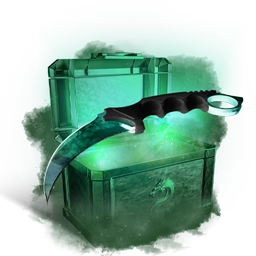
Few phenomena in modern gaming match the cultural impact and addictive allure of the Counter-Strike: Global Offensive (and now Counter-Strike 2) case opening system. Since weapon finishes were introduced to the game via the “Arms Deal” update in August 2013, opening cases has evolved from a simple cosmetic mechanic into a multi-million-dollar digital economy, a spectator sport on streaming platforms, and for many players, a tempting gamble.
Understanding how CS:GO case openings work requires looking past the dazzling animations and neon lights to examine the mathematics, the economics, and the psychology behind the drop.
How Case Openings Work
To open a case in Counter-Strike, players need two things: a Weapon Case and a Key.
- Cases are obtained as random drops by simply playing on official or community servers, or by purchasing them directly from the Steam Community Market.
- Keys must be purchased directly from the in-game store for a flat rate of £2.50 GBP (or regional equivalent).
Once a key is used on a case, a spinning reel animation displays a variety of weapon skins scrolling past before finally stopping on one item. That item is then added directly to the player’s inventory.
Understanding the Odds: The Mathematics of Drops
One of the most heavily debated and researched aspects of case openings is the actual probability of receiving rare items. While Valve does not officially publish exact percentages for every single item, extensive community-driven data collection (involving millions of opened cases) has provided a clear picture of the odds.
Estimated Item Drop Probabilities
| Rarity Tier | Item Classification | Estimated Drop Rate |
|---|---|---|
| Blue | Mil-Spec Grade (Common) | ~79.92% |
| Purple | Restricted (Uncommon) | ~15.98% |
| Pink | Classified (Rare) | ~3.20% |
| Red | Covert (Mythical) | ~0.64% |
| Yellow / Gold | Special Rare (Knives / Gloves) | ~0.26% |
(Note: Within each tier, there is an additional ~10% chance that the weapon will drop in StatTrak condition, which tracks the number of kills made with that weapon).
As the data shows, players have roughly a 1-in-400 chance of unboxing a knife or pair of gloves. This statistical reality is the foundational pillar of the game’s economy: rare items remain rare because the vast majority of openings result in lower-tier blue and purple skins that are worth less than the £2.50 key used to open them.
The Steam Community Market and Third-Party Sites
The existence of case openings birthed an entire virtual economy. Because items can be traded and sold, a marketplace emerged where digital pixels command real-world currency values.
- The Steam Community Market: This is the official ecosystem where players can buy and sell skins using Steam Wallet funds. Valve takes a transaction fee (roughly 15%) on every sale.
- Third-Party Marketplaces: Platforms outside of Steam allow users to trade skins for cryptocurrency or fiat cash, though these come with varying degrees of regulatory oversight and security risks.
- Case Opening Sites: External websites allow users to open simulated cases with different odds or custom item pools. Players should exercise extreme caution, as many of these sites operate in legal gray areas and are associated with gambling addiction and scams.
The Psychology of the Spin: Why Do We Open Cases?
Why do millions of players continue to spend money on digital keys knowing that the mathematical odds are against them? The answer lies in behavioral psychology.
- Variable Ratio Reinforcement: This is the exact psychological mechanism that makes slot machines addictive. Because rewards are random and unpredictable, the brain releases a surge of dopamine not just when a reward is received, but in anticipation of the reward.
- Near-Misses: Watching a rare knife slow down and stop just one pixel away from the center line triggers a “near-miss” effect. The brain interprets this as being “close” to winning, which actually encourages further spending.
- Community and Streaming Culture: Twitch streamers and YouTubers opening hundreds or thousands of cases at a time amplify the visibility of massive wins. Viewers rarely see the thousands of dollars lost off-camera; they only remember the ecstatic reaction of a streamer pulling a factory-new knife worth thousands of dollars.
Best Practices for Enthusiasts
If you choose to participate in case openings, keeping a level head and managing your expectations is essential to avoid financial regret.
Dos and Don’ts of Case Openings
- DO treat case opening as entertainment, not as an investment strategy or a way to make money.
- DO set a strict budget before you start and never chase your losses by buying “just one more key.”
- DO consider buying the specific skin you want directly from the community market, which is almost always cheaper than trying to unbox it yourself.
- DON’T use money meant for essential living expenses (rent, food, bills) to buy keys.
- DON’T fall for external website scams promising guaranteed profits or rigged case-opening odds.
- DON’T view virtual items as guaranteed financial assets; Valve can (and does) update economic policies that can shift market prices overnight.
Frequently Asked Questions (FAQ)
1. Are CS:GO case openings considered gambling?
Legally and functionally, yes. Because you are spending real money for a chance-based reward of variable monetary value, many countries classify case openings and loot boxes as forms of gambling. Several European nations have implemented strict regulations or outright bans on loot box mechanics in video games.
2. Can I make a profit by opening cases?
Statistically, no. Over a large sample size, the average return on investment (ROI) for opening CS:GO/CS2 cases hovers around 40% to 50%. This means for every £100 you spend on keys and cases, you will likely only get back £40 to £50 worth of digital items. While rare individual anomalies occur, the house always wins mathematically over time.
3. Did case openings transfer over to Counter-Strike 2 (CS2)?
Yes. Valve carried over all inventories, weapon finishes, cases, and keys from CS:GO into Counter-Strike 2. The case opening mechanics, odds, and animations received a massive visual overhaul in the new engine, making them look flashier than ever, but the underlying probabilities remain largely the same.
4. What happens to low-tier skins I don’t want?
Players don’t have to let unwanted blue and purple skins sit in their inventory. Valve includes a Trade-Up Contract feature. By trading in 10 skins of the exact same rarity tier, players can exchange them for one random skin of the next higher rarity tier. This is a popular way to recycle unwanted drops in hopes of hitting a higher-tier payout.
CS:GO case openings remain a fascinating cultural touchstone of modern PC gaming. They combine the thrill of the lottery with the passion of collecting digital art. However, approaching them requires a healthy dose of realism. By understanding the math, recognizing the psychological triggers at play, and treating the experience purely as a form of paid entertainment, players can enjoy the excitement of the drop without letting the house empty their wallets.
Try CS2 Cases on CS2Skin to uncover CS2 skin possibilities, enjoy a smooth experience, and chase standout virtual drops.